
Encodings and detection
The conversion pipeline
Every file takes the same path:
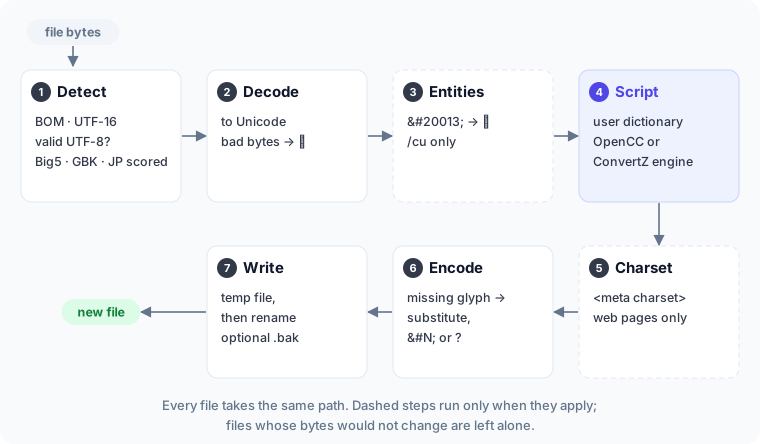
- Detect the encoding (skipped when you give the source encoding).
- Decode to Unicode. Invalid bytes become
�and are counted. - Entities: with
/cu(or the setting),&#NNNN;and&#xHHHH;become text. - Script: convert according to the script setting and engine; see Conversion engines.
- Charset: web-page file types only.
- Encode into the target encoding, handling characters it lacks.
- Write to a temporary file and rename it. Nothing is written when the bytes would not change.
Supported encodings
| Encoding | Notes |
|---|---|
| Big5 | Traditional Chinese, Taiwan and Hong Kong (Windows code page 950) |
| GBK | Simplified Chinese (code page 936); it also has Traditional characters |
| UTF-8 | BOM optional |
| UTF-16 LE / BE | Always written with a BOM |
| HZ | 7-bit GB2312 from early e-mail and Usenet (RFC 1843) |
| Shift_JIS, EUC-JP, ISO-2022-JP | Japanese |
Big5, GBK and the Japanese encodings go through encoding_rs, the library Firefox uses, following the WHATWG Encoding Standard. HZ is implemented in RustZ.
Detection
Detection checks, in order (NUL bytes, ASCII and UTF-8 validity are checked over the whole file; UTF-16 and the scoring use up to 256 KB):
BOM:
EF BB BFis UTF-8,FF FEis UTF-16 LE,FE FFis UTF-16 BE.UTF-16 without a BOM: mostly-ASCII UTF-16 has a zero in every other byte. If more than 30% of one side is zero and less than 5% of the other, it is UTF-16.
Binary: anything else containing NUL bytes is treated as binary and skipped during detection.
7-bit encodings: with no byte above 0x7F, an escape sequence such as
ESC $ Bmeans ISO-2022-JP,~{…~}means HZ, and otherwise it is plain ASCII (handled as UTF-8).UTF-8: if the whole sample is valid UTF-8, it is UTF-8.
Scoring double-byte encodings: the sample is decoded as Big5, GBK, Shift_JIS and EUC-JP, and RustZ counts how many of the resulting characters are common ones:
- Big5 and GBK use ConvertZ's own frequency tables — the 144 most common characters and punctuation marks, one table per script.
- Japanese counts the share of hiragana and katakana.
- Invalid bytes, private-use characters and (for Shift_JIS) runs of half-width katakana count against an encoding.
Scoring starts just before the first non-ASCII byte, so a long English header does not push the Chinese text out of the sample. The highest score wins. With fewer than three common characters there is too little to go on: RustZ picks the encoding with the fewest invalid bytes and marks it as a guess (an orange "Big5?" in the app).
Short files
As ConvertZ's own manual warned, Big5 and GBK can be confused when a file has fewer than about a hundred Chinese characters. When a short file shows up as a guess, check the preview and pick the source encoding by hand if needed.
Missing characters
When the target encoding has no code for a character (such as 发 in Big5), RustZ tries, in order:
- A substitute, from ConvertZ's table of equivalents. Writing Big5, Simplified characters become Traditional (发 → 發) and variant forms from GBK's extension area become forms Big5 has. Writing GBK or HZ, characters become their Simplified or GBK forms. Half-width katakana become full-width.
- An entity: web-page file types get
&#NNNN;, which browsers display as the original character. - A question mark: other files get
?.
At the end RustZ reports how many characters needed step 2 or 3.
Charset declarations in web pages
In web-page file types, RustZ rewrites these declarations to the target encoding:
<meta charset="big5">,<meta http-equiv="Content-Type" content="text/html; charset=big5">, andcharset=big5in code.- The XML declaration
<?xml version="1.0" encoding="big5"?>.
Only values that are recognised encoding names are replaced (a variable assignment like charset = name is left alone). The names written are big5, gbk, utf-8, utf-16, shift_jis, euc-jp, iso-2022-jp and hz-gb-2312.
Entities
中 (decimal) and 中 (hex) both become 中. Values below U+0080 are left alone, so < (<) and friends never turn back into HTML syntax.